
WHAT HAPPENED
The important news is that India has now entered negotiations on the proposed Shanghai Cooperation Organisation (SCO) Development Bank, alongside the other SCO members. The proposal is no longer merely a political idea: member states are working on the founding documents, governance structure and capital arguements. The issue was also discussed between Indian Finance Minister Nirmala Sitharaman and Russian Finance Minister Anton Siluanov on the sidelines of the G20 Finance Minister’s meeting in the US.
This is significant for India because the proposed institution sits at the intersection of development finance, de-dollarisation, sanctions, Central Asian Connectivity, India’s strategic autonomy and the changing global financial order.
First Understand: What is the SCO?
The Shanghai Cooperation Organisation (SCO) is a Eurasian multilateral organisation whose original core consisted China, Russia and the Central Asian States.
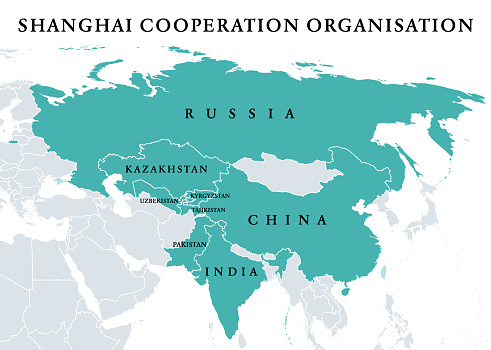
It was formally established in 2001
India and Pakistan became full members in 2017. Iran subsequently joined, and Belarus became a member in 2024.
Today the SCO has 10 members, including:
- India
- China
- Russia
- Pakistan
- Kazakhstan
- Kyrgyztan
- Tajikistan
- Uzbekistan
- Iran
- Belarus
The organisation deals with much more than security.
Its agenda increasingly includes:
Security->Counter-terrorism->Trade->Energy->Connectivity->Finance->Technology->Development
That expansion is crucial to understanding why a development bank is being discussed.
What exactly is an SCO Development Bank?
Think of it as a potential multilateral development-financing institution for SCO countries.
A development bank generally provides long-term finance for projects such as:
- infrastructure
- transport
- energy
- industrial development
- technology
- digital infrastructure
- cross-border connectivity
- potentially environmental and development projects
For example, imagine India, Russia and a Central Asian country agree to develop a major transport strategy project.
Instead of depending entirely on:
- Western commercial banks,
- the World Bank,
- Asian Devolopment Bank,
- private international lenders,
an SCO development bank could potentially provide financing.
That is the basic economic logic.
The SCO itself says consultations have been taking place on the key elements of the proposed bank, including how it would function and the next steps. The latest consultation meeting was held in Shenzhen in June 2026.
“The SCO Development Bank has been established.”
The present situation is:
Political agreement->negotiations->founding documents->governance/capital discussions->eventual establishment
The political concensus to establish the bank was reached at the 2025 SCO Summit in Tianjin, China
Subsequently, several rounds of consultants have taken place.
The SCO’s official record says the fourth consultation meeting occured in Shenzehen on 29-30 June 2026, with representatives from 28 countries participating, and that members continued discussions on the key elements and workplan for establishing the bank.
Therefore,
SCO Development Bank= proposed/in-the-process-of-being-established institution, not an operational bank.
What happened at the 2026 Bishkek Summit?
The latest development came at the 26th SCO Council of Heads of State Summit in Bishkek, Kyrgystan, held on August 31-September 1, 2026
The summit gave political banking to continuing the process.
The Bishkek declaration called for consultations on the founding documents to be completed as quickly as possible.
This is important because the discussion has moved beyond:
“Should we have a bank?”
towards:
“How exactly should the bank be structured?”
That is a much more advanced stage.
What is India Doing?
India is participating in the negotiations.
This is important because India has historically been cautious about proposals that could create a financial institution heavily dominated by one or two major powers.
According to the report, SCO members are discussing:
A. Governance
Questions include:
- Who will control the institution?
- How will voting rights be distributed?
- Will voting correspond to capital contribution?
- What role will smaller SCO countries receive?
- Who will appoint the leadership?
- Where will headquarters be located?
B. Capital
They also need to determine:
- authorised capital
- subscribed capital
- individual country contributions
- paid-in-capital
- lending capacity
- borrowing mechanisms
- currency of operations
Why does Russia strongly support the idea?
The geopolitical dimension is particularly important.
Russian President Vladmir Putin has strongly advocated creating the bank.
His arguement is that international financial systems can be used as instruments of geopolitical pressure.
This is directly related to Russia’s experience with Western sanctions.
Putin therefore wants the proposed bank to be as independent as possible from financial systems that can be used to exert unilateral economic leverage.
Russia’s Logic
Western sanctions->restrictions on financial transactions->dependence on Western financial infrastructure becomes a vulnerability->create alternative mechanisms.
This is why the proposal has a de-dollarisation/financial sovereignty dimension.
But it would be inaccurate to describe the bank simply as ann “Anti-American Bank.”
Its official economic rationale is broader.
financing development and strengthening economic and financial cooperation among SCO members.
The geopolitical interpretation is an additional layer.
Russia’s national-currency experiment
Putin said that Russia’s trade with SCO countries exceeded $400 billion in the previous year, with national currencies according for more than 98% of Russia’s mutual settlements with SCO members.
This demonstrates the direction in which Russia wants the SCO financial system to move.
Instead of:
Rouble->Dollar->Rupee
or
Rouble->Dollar->Yuan
countries could increasingly use:
Rouble<->Rupee
Rouble<->Yuan
Rupee<->Tenge
etc.
But there is a major distinction: de-dollarisation ≠ replacing the dollar overnight
A development bank cannot automatically create a successful alternative international currency system.
Why?
Because an international currency needs:
- deep financial market
- convertibility
- liquidity
- confidence
- stable institutions
- reliable payment infrastructure
- large pools of investable assets.
Therefore, creating an SCO bank is much easier than creating a genuine alternative to the
dollar-dominated global financial system.
The bank could nevertheless contribute to gradual diversification.
Why does Kazakhstan want to host it?
Kazakhstan has also expressed interest in hosting the bank.
President Kassym-Jomart Tokayev proposed that Kazakhstan could host the institution and its headquarters if there is consensus among member states.
He suggested directing resources primarily towards:
- infrastructure
- technological projects
- industrial projects.
This makes strategic sense for Kazakhstan.
Kazakhstan is:
- geographically central to Eurasia
- resource-rich
- strategically located between China, Russia and Europe
- an important Central Asian economy.
A major multilateral financial institution headquartered there could strengthen Kazakhstan’s position as a regional financial and logistical hub.
Kyrgyzstan also wants to host the bank!
Interestingly, Kyrgyzstan has also expressed interest in hosting the institution.
So there is already a potential competition over headquarters.
This may appear like a minor diplomatic issue, but headquarters can bring:
- international prestige
- skilled jobs
- financial-sector development
- diplomatic influence
- investment
- associated institutions
- conferences and international visibility.
Thus, the headquarters question could become part of the negotiations.
Why is China important?
China is arguably the most important economic player in the SCO.
China has enormous financial resources and extensive experience in development finance.
It already has institutions such as:
- Asian Infrastructure Investment Bank (AIIB)
- Silk Road Fund
- China Development Bank
- China also has the Belt and Road Initiative.
The SCO Development Bank could therefore potentially complement China’s existing regional economic architecture.
But there is an important issue for India:
Would the new institution become China-dominated?
That is one of the questions India will naturally have to consider.
China’s economic weight inside the SCO is enormous.
Great article! Very informative and easy to understand. Thanks for sharing such useful information.